
StarLink vs. LTE
Pros and cons for remote QTH operations
I had been waiting for StarLink to come to Kazakhstan for two years. Eventually, it came in Q3 2025. However, it was too late (and too cold) for a DXpedition to the Assy-Turgen Observatory.
Since then, it has been waiting for usage for several months in the “parking mode”. You pay a few EUR/month but don’t use it.
However, I experienced several nasty outages with the local LTE provider – Beeline – for my remote QTH, since I operate 99% of the time remotely from my apartment in Almaty – about 50 km from the QTH. The speed – fantastic – 100+ Mbps. Ping – brilliant – 30 ms or around… while you are just pinging. However, as soon as you try to use the UDP for voice – 200-300 kbps gross, it looks like the connection chokes and the ping jumps to 600-1600 ms, which is killing, and the remote voice doesn’t work. TeamViewer for FT8 still works fine.
Typically, I rebooted the LTE modem, lost a few minutes while it did, Beeline allocated more resources or something to my LTE router, ZeroTier caught up with the new connection, and it worked. Often, but not always. In any case, such steps were annoying, interrupting, and not guaranteeing. It didn’t solve the problem. Other days, in the same setup, in the same time, in the same conditions – no problem.
In short: a highly unpredictable issue likely caused by the LTE operator, since I pinged and tested while on site – to remove the uncertainty due to my home’s GPON provider or ZeroTier.
StarLink
StarLink offers high speed, low latency, and reasonable cost for my purposes. However, despite all this, I plan to return to the LTE provider:
- When LTE struggles, its latency jumps, presumably, due to poor network planning LTE spectrum resource allocation or something. I can fight for it for some minutes, then I give up, and return, when the connection self-heals
- The increased latency of 300-600 ms doesn’t drop Icom’s RS-BA1 or the app for the PA. I cannot use voice, because of lost packets, but I can monitor and listen, and more or less feel the air
- With StarLink, the story is different … They have a latency of 30-35 ms – very good. But then – 1-10% of the time – it just loses the connection entirely for 1-5 seconds. Completely. During this time, RS-BA1 cancels the connection, PA’s app drops. I cannot just restart them. I need to close them – takes 10 seconds or so. And then reopen one by one – also 30-60 seconds, because Icom’s software isn’t logical and requires a few unnecessary steps to be done in sequence. As a result, if the interruption occurs while I am CQing, it is highly embarrassing; if it happens when a DX replies to me, no one would wait for me, and I would lose the call, which nearly happened with 3Y0K in 2026. I was lucky to return quickly enough. But it was a very close call, and I managed quicker, because I was physically on site, though I always run remote operations, even when I am physically at the QTH


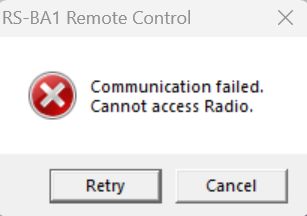

So, I am planning to return to “old warm LTE” instead of modern high-tech StarLink. Not guaranteed that I will not reverse the decision, since I wasn’t too happy about the LTE in the first place.
Combining two sounds like a wise idea, but it is not without risks and caveats:
- I have several connectivity users at the QTH: 1) remote Windows PC, 2) PA, 3) Pi that can reboot the Icom transceiver physically, because it may be stuck and stop sending CI-V messages to the Remote Control Unit, and I lose the automatic antenna switching depending on the band, and it can reboot the PC that doesn’t wake up, when I have a long electricity cutoff. I need to physically press the Power/Reset button, which I do from the Pi
- PC is WiFi connected. Pi could be WiFi connected, but it seems to be broken. The PA is only Ethernet connected
- So, I have a WiFi repeater from StarLink installed on the roof to the local users, mostly the PA that doesn’t have WiFi capability and the StarLink doesn’t have any Ethernet ports
- However, if I try to employ the dual-connectivity approach – StarLink and LTE – I need to choose the physical Ethernet connectivity – either LTE or StarLink. Maybe, there are even complicated setups possible, but I risk suddenly cutting myself off from the remote connection due to some strange collision or switching something to some mode, and, thus, I would have to drive 60 km in one direction to fix a 1-minute problem