
Remote Power Amplifier
More power for 6m for a remote mast
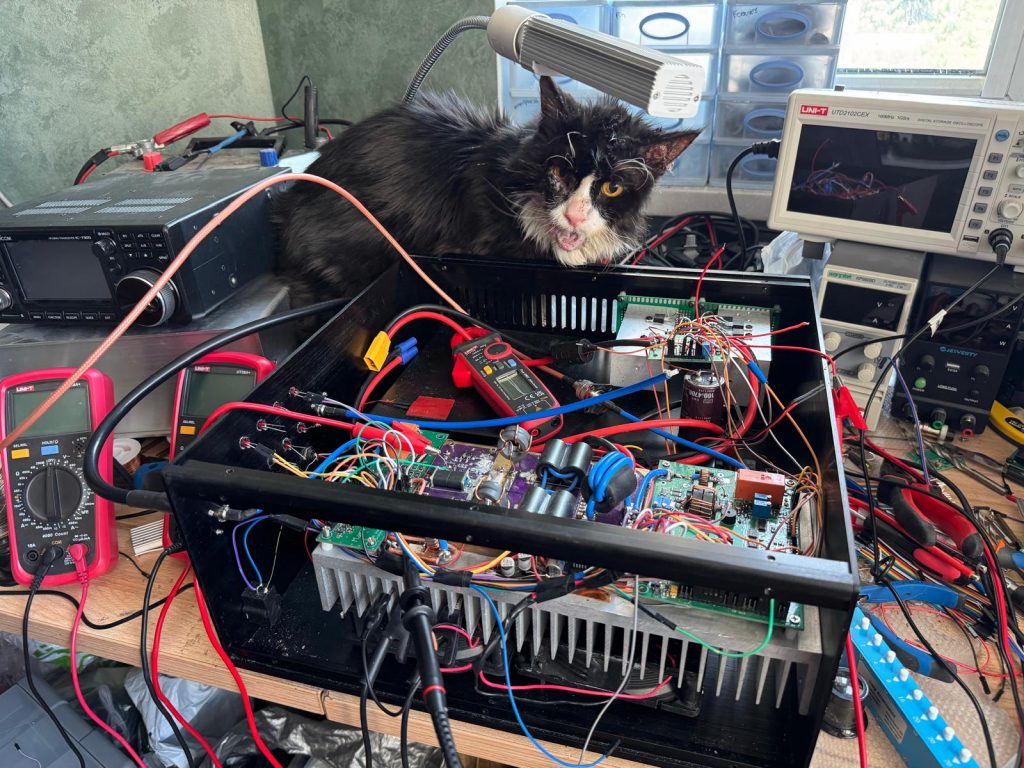
Intro
I tried to refrain from building power amplifiers or transceivers for a long time, since it is a very time-consuming activity and I am trying to minimize radio hobby affecting my work 🙂
Antenna switches, some basic software to control something – OK. It is a nice hobby activity. But amplifiers or transceivers are in a separate league of complexity. Thus, I intentionally purchased a commercial amplifier a couple of years ago to prevent myself from spending time building it.
However, since breaking for the 1st time in the mid of 2025, it keeps breaking and showing nonsense with SWR and power measurements; and, recently, not working entirely on some bands. However, unlike your own design, you don’t have schematics and very poor support and sending to another country 17-kg net PA, waiting for some months (they don’t confirm any particular schedule – “when your queue comes”), and then getting it back, when you already accustomed to live without the PA, it is not what you enthusiastically do. So, got I tired with it.
Thinking logically, I may still send it to repair, which will cost about 1 kEUR. But they promised to completely replace the main board. Instead of 2 x BLF188XR, there will be 4 x (MRF300A+MRF300). It have some merits in terms of power and the cost of repair since the MRF300A+MRF300 are substantially cheaper a piece and generally more available. Let’s see.
Thus, it is time to building something of your own.
Building an LDMOS amplifier is a very easy thing – it is just one power transistor stage. You can do it in a couple of hours, if you have ready boards from Alibaba:
- Solder the transistor to the copper base
- Solder the transistor to the boards
- Provide the power
- Tune the initial current to 0.5-1 A
- Have the low-pass filters switchable
- And you are ready to go with 800-1000 W output
Easy? – It is very easy.
It is easy to build the PA pallet. But it is very difficult to make the protection circuits for the PA, particularly, knowing that sooner or later, they will fail you (“we all will die” 🙂 and the only fight is to extend the life of the PA as much as possible, because, if unlucky or careless, the transistor (160-800 USD in 2026) may live milliseconds 🙂
2026.Jul.15
Building anything complex, it is nearly always like playing The House That Jack Built:
- In order to have successful EME on 2 meters, you need good antennas (good PA and LNA as well, but, first of all, the antennas)
- But the tower is already occupied by the 6-meter Yagi. So, you need to move the 6-meter Yagi to the taller tower and place it higher to have a smaller angle of receiving/transmitting to the horizon
- But tall towers are typically at some distance from your transceiver. The cables are long, and the losses are high
- So, you have to build a remote PA, control it remotely, and not only the PA, but the LNA and sequencer… and everything – remotely controlled
- To build the PA, you need to build the load. You can load 100-200 W from your transceiver with a single 3-10-USD 50-Ohm resistor and some decent radiator. But it’s not a big deal. You can build it and test it in under 1 hour. But building a 1-2 kW 50-Ohm load is a project of its own: large physical size, massive copper plate, ventilation, or oil and ventilation
- But how even to measure the power? Oscilloscope? … – I fried a few probes… with 1.5 kW raw output, you have 548 peak-to-peak voltage with ideal SWR=1.0. But you can easily have it far less than ideal, i.e., you need a fair margin… it is impossible to find such probes or they are expensive
- OK, you need a separate small project for the coupler just to measure the power. The coupler must have a wide bandwidth, and the measured specs, because it is your measurement device now
- But before you can achieve high-output RF power, you need to build the PA protection circuits, right? Input power protection, output power protection, reflected power protection, temperature protection, current protection. Oh! Current protection… but how do you even measure 40-50 A? With such current, you can do welding. But you don’t need welding. You want a PA …
- So, you build a separate resistive or active transistor load that can draw at least 2-3 kW for a few seconds, so you can set current triggers in your current protection circuit, right?
And so on, and so forth. The project within the project and several of its branches.
To build a high tower (500-600 meters) in 1950-1960, you first need to invent a special concrete. And not only invent it, but also produce it with consistent quality in large quantities. To do that, you build the concrete factory right on the tower site. To pour concrete at a height of 400 meters, or even to raise massive concrete blocks, you first invent and build special machines that can self-raise on the tower.
You see similar patterns in every challenging project. That is the essence of any engineering task worth pursuing. As soon as you spot the project structure like that, you know that you are building something interesting 🙂
So, I have some power at the PA output. I again broke just another oscilloscope probe. It is time to quickly build and calibrate a coupler, because I have only a vague idea on what the real output power currently is and cannot even more on.